Trace the five exact structural mutations—Pre-RMSNorm, RoPE, Grouped-Query Attention, SwiGLU, and Top-K Sparse MoE—that turned the 2017 Transformer into modern open-weights frontier models.
1.Five mutations between 2017 and modern frontier decoders#
Every modern open-weights language model—whether Llama-3, Qwen, Mixtral, or DeepSeek—remains a decoder-only descendant of Vaswani et al.'s 2017 Transformer. Yet if you compare a 2017 block against a 2024–2026 production block line by line, not a single sub-layer is left untouched. Four distinct systems bottlenecks forced five standardized mutations:
- Deep residual gradient instability and memory-bound normalization drove the shift from Post-LayerNorm to Pre-RMSNorm.
- Length extrapolation failure and entangled position-content projections replaced additive sinusoidal embeddings with Rotary Position Embeddings (RoPE).
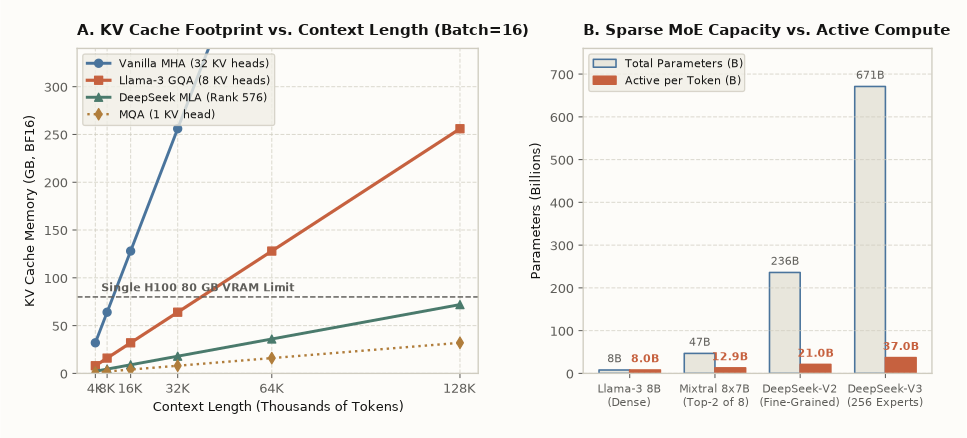
- Autoregressive KV cache memory capacity and HBM bandwidth saturation compressed Multi-Head Attention (MHA) into Multi-Query (MQA) and Grouped-Query Attention (GQA).
- Expressivity bottlenecks in dense point-wise feed-forward layers replaced two-matrix ReLU blocks with three-matrix bias-free SwiGLU gates.
- The strict coupling between total parameter capacity and per-token FLOPs split dense feed-forward networks into Top- Sparse Mixture-of-Experts (MoE) layers.
| Architectural Component | 2017 Vanilla Transformer | Modern Standard (Llama-3 / Mixtral) | Primary Systems & Numerical Payoff |
|---|---|---|---|
| Normalization Placement | Post-LN: | Pre-RMSNorm: | Unimpeded identity gradient highway; single-pass variance reduction |
| Positional Encoding | Additive Sinusoidal at input | Multiplicative RoPE inside each layer | Exact relative-distance dot product |
| Attention KV Heads | MHA () | GQA (, e.g. vs ) | smaller KV cache footprint and less HBM decode traffic |
| Feed-Forward Network | SwiGLU: | Multiplicative gating with zero bias parameters | |
| Parameter Sparsity | Dense ( weights active) | Top- Sparse MoE (e.g. of ) | Decouples model knowledge capacity () from active compute () |
2.From Post-LayerNorm to Pre-RMSNorm#
The 2017 Transformer applied LayerNorm after the residual addition:
During backpropagation, the gradient with respect to the bottom layer must pass through the Jacobian of every intermediate LayerNorm operator. Near initialization, variance rescaling compounds across depth , amplifying gradients near the output layer while attenuating gradients in early layers. Training deep Post-LN stacks required fragile learning-rate warmup schedules.
Moving normalization inside the residual branch (Pre-Norm) creates a clean identity path from the loss all the way to the embedding layer:
Simultaneously, Zhang and Sennrich showed that LayerNorm's mean-centering step () and additive bias contribute negligible accuracy gains while requiring two sequential reduction passes over High Bandwidth Memory (HBM). RMSNorm discards mean centering and normalizes strictly by the root mean square:
A critical production detail appears in mixed-precision (bfloat16 or float16) kernels: squaring activations can easily overflow the float16 dynamic range () or lose precision during reduction. Industrial implementations always cast to float32 before computing the reciprocal square root rsqrt, then cast the normalized tensor back to the working precision before multiplying by .
3.Rotary Position Embeddings and complex-plane invariance#
Adding a positional vector to the input token embedding entangles semantics and position. Once is multiplied by and across dozens of layers, the attention logit expands into four cross-terms where positional distance is mixed with arbitrary projection matrices.
Su et al. (RoFormer, arXiv:2104.09864[3]RoFormer: Enhanced Transformer with Rotary Position EmbeddingOpen arXiv:2104.09864 ↗) formulated a cleaner requirement: find an operator and such that the inner product depends exclusively on the vectors and their relative distance :
In two dimensions, rotation in the complex plane satisfies this identity immediately. If we rotate by angle and by angle , the orthogonal rotation matrices obey :
For a head dimension (such as in Llama-3), RoPE partitions the feature vector into independent two-dimensional subspaces. Each pair rotates at a geometric frequency (where in standard RoFormer and in Llama-3 to support context):
Represent each 2D feature pair as a complex number . Applying RoPE at position multiplies by . The inner product between rotated query at position and rotated key at position is:
Because the right-hand side depends on and strictly through their difference , any two token pairs separated by the same offset experience the exact same positional rotation operator.
class RMSNorm(nn.Module):
    def __init__(self, dim: int, eps: float = 1e-6):
        super().__init__()
        self.eps = eps
        self.weight = nn.Parameter(torch.ones(dim))

    def forward(self, x: Tensor) -> Tensor:
        # Accumulate mean-square in float32 to prevent BF16/FP16 overflow before scaling.
        orig_dtype = x.dtype
        x_fp32 = x.float()
        rms = torch.rsqrt(x_fp32.pow(2).mean(dim=-1, keepdim=True) + self.eps)
        return (x_fp32 * rms).to(orig_dtype) * self.weight


def precompute_rope_cos_sin(head_dim: int, max_seq_len: int, base: float = 10000.0) -> tuple[Tensor, Tensor]:
    if head_dim % 2 != 0:
        raise ValueError("head_dim must be even for 2D complex-plane rotation")
    inv_freq = 1.0 / (base ** (torch.arange(0, head_dim, 2, dtype=torch.float32) / head_dim))
    positions = torch.arange(max_seq_len, dtype=torch.float32)
    angles = torch.outer(positions, inv_freq)
    return torch.cos(angles), torch.sin(angles)


def apply_rope(x: Tensor, cos: Tensor, sin: Tensor) -> Tensor:
    # x shape: [B, H, T, D]
    seq_len = x.shape[2]
    cos_t = cos[:seq_len, :][None, None, :, :]
    sin_t = sin[:seq_len, :][None, None, :, :]
    x_even = x[..., 0::2]
    x_odd = x[..., 1::2]
    rot_even = x_even * cos_t - x_odd * sin_t
    rot_odd = x_even * sin_t + x_odd * cos_t
    return torch.stack([rot_even, rot_odd], dim=-1).flatten(-2)
In our companion CPU verification (labs/llm/modern-transformer), evaluating versus for identical vectors at distance yields inner products that agree to within in float32 and in float64. Notice also that RoPE is applied only to and at every layer—never to —preserving pure content aggregation in the value weighted sum.
4.Breaking the KV cache wall: MHA to MQA and GQA#
Autoregressive inference splits into two hardware regimes. During Prefill, all prompt tokens are processed in parallel via dense matrix-matrix multiplications (GEMM), easily saturating GPU Tensor Cores. During Decode, the model generates one token at a time; every step must stream the entire model weight parameters plus all historical Key and Value tensors (KV Cache) from HBM for a single token's matrix-vector product (GEMV).
The exact BF16 KV cache capacity ledger is:
Consider a 32-layer Llama-3-8B architecture () serving a batch of sequences at context length :
- Vanilla MHA (): Requires of KV cache—more than the footprint of the model weights themselves, overflowing three 80 GB H100 GPUs.
- Multi-Query Attention (MQA, Shazeer 2019, ): All query heads share a single Key and Value head. The KV cache drops to , at the cost of measurable quality degradation on complex reasoning tasks.
- Grouped-Query Attention (GQA, Ainslie et al. 2023, ): Queries are partitioned into groups of heads each; every group shares one Key and Value head. The KV cache shrinks by to , matching MHA perplexity while cutting decode HBM traffic by .
5.SwiGLU and Top-K Sparse Mixture-of-Experts#
In a Llama-3-8B block, the GQA module holds parameters ( and ), whereas the SwiGLU feed-forward network holds parameters—over of every transformer layer:
Because the feed-forward network stores the vast majority of parametric knowledge, scaling a dense model forces compute FLOPs ( per token) to grow linearly with total parameter count . Sparse Mixture-of-Experts (MoE)—pioneered at trillion-parameter scale by Switch Transformer () and standardized for open weights by Mixtral 8x7B ()—replaces the single dense FFN with parallel SwiGLU experts gated by a lightweight router :
class GroupedQueryAttention(nn.Module):
    def __init__(self, hidden_size: int, num_q_heads: int, num_kv_heads: int, head_dim: int):
        super().__init__()
        if num_q_heads % num_kv_heads != 0:
            raise ValueError("num_q_heads must be divisible by num_kv_heads")
        self.num_q_heads = num_q_heads
        self.num_kv_heads = num_kv_heads
        self.group_size = num_q_heads // num_kv_heads
        self.head_dim = head_dim
        self.wq = nn.Linear(hidden_size, num_q_heads * head_dim, bias=False)
        self.wk = nn.Linear(hidden_size, num_kv_heads * head_dim, bias=False)
        self.wv = nn.Linear(hidden_size, num_kv_heads * head_dim, bias=False)
        self.wo = nn.Linear(num_q_heads * head_dim, hidden_size, bias=False)

    def forward(self, x: Tensor, cos: Tensor, sin: Tensor) -> tuple[Tensor, int]:
        b, s, _ = x.shape
        q = self.wq(x).view(b, s, self.num_q_heads, self.head_dim).transpose(1, 2)
        k = self.wk(x).view(b, s, self.num_kv_heads, self.head_dim).transpose(1, 2)
        v = self.wv(x).view(b, s, self.num_kv_heads, self.head_dim).transpose(1, 2)
        q = apply_rope(q, cos, sin)
        k = apply_rope(k, cos, sin)
        # Only the unexpanded KV heads are stored in the persistent KV cache (2 bytes per BF16 element).
        kv_cache_bytes = 2 * k.numel() * 2
        if self.group_size > 1:
            k = k.repeat_interleave(self.group_size, dim=1)
            v = v.repeat_interleave(self.group_size, dim=1)
        scores = (q @ k.transpose(-2, -1)) / math.sqrt(self.head_dim)
        mask = torch.triu(torch.full((s, s), float("-inf"), device=x.device), diagonal=1)
        probs = F.softmax((scores + mask).float(), dim=-1).to(x.dtype)
        out = (probs @ v).transpose(1, 2).contiguous().view(b, s, -1)
        return self.wo(out), kv_cache_bytes


class SwiGLUFFN(nn.Module):
    def __init__(self, hidden_size: int, intermediate_size: int):
        super().__init__()
        self.w_gate = nn.Linear(hidden_size, intermediate_size, bias=False)
        self.w_up = nn.Linear(hidden_size, intermediate_size, bias=False)
        self.w_down = nn.Linear(intermediate_size, hidden_size, bias=False)

    def forward(self, x: Tensor) -> Tensor:
        return self.w_down(F.silu(self.w_gate(x)) * self.w_up(x))


class SparseMoEBlock(nn.Module):
    def __init__(self, hidden_size: int, intermediate_size: int, num_experts: int = 8, top_k: int = 2):
        super().__init__()
        self.num_experts = num_experts
        self.top_k = top_k
        self.router = nn.Linear(hidden_size, num_experts, bias=False)
        self.experts = nn.ModuleList([SwiGLUFFN(hidden_size, intermediate_size) for _ in range(num_experts)])

    def forward(self, x: Tensor) -> tuple[Tensor, Tensor]:
        b, s, h = x.shape
        flat = x.view(-1, h)
        logits = self.router(flat)
        top_logits, top_indices = torch.topk(logits, self.top_k, dim=-1)
        weights = F.softmax(top_logits.float(), dim=-1).to(x.dtype)
        out = torch.zeros_like(flat)
        for idx in range(self.num_experts):
            token_idx, k_pos = torch.where(top_indices == idx)
            if token_idx.numel() > 0:
                expert_out = self.experts[idx](flat[token_idx])
                out.index_add_(0, token_idx, expert_out * weights[token_idx, k_pos].unsqueeze(-1))
        counts = torch.bincount(top_indices.view(-1), minlength=self.num_experts).float()
        return out.view(b, s, h), counts / counts.sum()
In Mixtral 8x7B, each layer contains experts, but every token routes to only experts. Total model parameters reach (which must reside in HBM), yet each token executes only active parameters—delivering the knowledge capacity of a model at the latency and FLOP budget of a model.
Run the complete CPU verification suite to inspect RoPE invariance, GQA cache compression, and Top- MoE routing:
labs/.venv/bin/python -m unittest discover -s labs/llm/modern-transformer -p 'test_*.py' -v
labs/.venv/bin/python labs/llm/modern-transformer/modern_blocks.py6.References and next chapter#
- Vaswani et al., Attention Is All You Need (2017).
- Su et al., RoFormer: Enhanced Transformer with Rotary Position Embedding (2021).
- Ainslie et al., GQA: Training Generalized Multi-Query Transformer Models from Multi-Head Checkpoints (2023).
- Jiang et al., Mixtral of Experts (2024) & Dubey et al., The Llama 3 Herd of Models (2024).
- Continue to Chapter 2: The AI Infrastructure Ledger: Roofline Analysis, FlashAttention-2, and PagedAttention.
References
- [1]
- [2]
- [3]
- [4]
- [5]
- [6]
- [7]