How 2026 frontier models break the symmetric Decoder-only and Pre-RMSNorm mold: DeepSeek-V4.1-Flash asymmetric CED and 890 B/tok KV compression, Kimi K3 Attention Residuals, Qwen3.8-Next 4-branch gated residuals, and Muon orthogonalized momentum.
1.Why symmetric Decoder-only + Pre-RMSNorm hit a wall#
Between 2018 and 2024, frontier language models converged on a single template: a uniform stack of symmetric Decoder-only blocks connected by a Pre-RMSNorm residual bus (modern-transformer-evolution). Under 100K-to-1M-token agentic workloads—where a coding or deep-research agent ingests an entire repository and emits only a few hundred tool-call tokens—that template breaks along three hardware axes:
- Prefill-to-Decode Asymmetry (
1000 : 1): A symmetric Decoder-only model forces every input token through the exact same heavy active parameter budget required for complex next-token reasoning. - Depth-Wise Representation Dilution: Beyond layers, summing every layer's output onto one additive residual bus inflates deep-layer activation norms and drowns out sharp lexical features from early layers.
- Ill-Conditioned Second-Order Optimizer Overhead:
AdamWtracks two FP32/BF16 states per parameter while leaving gradient updates dominated by top singular directions.
Late-2026 open-weight flagships—DeepSeek-V4.1-Flash (arXiv:2609.19969[5]DeepSeek-V4.1-Flash: Pushing the Limits of KV Cache CompressionOpen arXiv:2609.19969 ↗), Qwen3.8-Flash-Next (arXiv:2608.30320[4]On the Design of Qwen3.8-Next Architecture: Evaluation, Efficiency, and Training StabilityOpen arXiv:2608.30320 ↗), Kimi K3 (arXiv:2607.24653[3]Kimi K3: Open Frontier IntelligenceOpen arXiv:2607.24653 ↗), and Nemotron 3.5 (arXiv:2610.38095[7]Nemotron 3.5 Super and Lightning: Open, Efficient Mixture-of-Experts Hybrid Mamba-Transformer Models for Agentic AIOpen arXiv:2610.38095 ↗)—independently converged on five coordinated mutations:
| Architectural Axis | DeepSeek-V4.1-Flash | Qwen3.8-Flash-Next | Kimi K3 / K3.1 Pro | Nemotron 3.5 Super |
|---|---|---|---|---|
| Scale & Active Ratio | 552B backbone + 196B Engram; 8B Prefill / 16B Decode | 125B MoE + 51B N-gram table; 6B active / token | 2.78T total / 104.2B active; 93 layers, 896 experts | 120B total / 12B active (Lightning: 30B-A3B) |
| Backbone Topology | Asymmetric CED (20 Causal Encoder + 20 Decoder layers) | Hybrid linear-sparse Decoder-only | Ultra-deep hybrid Decoder-only | Mamba-2 + Attention hybrid MoE |
| Sequence Mixing | CSA2 (cross-layer KV reuse + sparse indexer) + SWA replay | Gated DeltaNet (GDN) + Qwen Sparse Attention (QSA) | 3:1 hybrid: 3 KDA linear layers + 1 Gated MLA | Mamba-2 SSM + grouped-query attention |
| Residual Bus | Single-Pass mHC fused manifold hyper-connection |
4-Branch Gated Residual (GR) |
Attention Residuals (AttnRes) along depth |
Scaled Pre-RMSNorm |
| Precision & Optimizer | FP4 (E2M1) KV cache (890 B/tok) + Muon | Muon + off-accelerator Host DRAM N-gram lookup | MXFP4 weights + MXFP8 activations QAT + Muon | FP8 / NVFP4 deployment-friendly quantization |
2.Asymmetric CED and sub-kilobyte CSA2 KV compression#
DeepSeek-V4.1-Flash (arXiv:2609.19969[5]DeepSeek-V4.1-Flash: Pushing the Limits of KV Cache CompressionOpen arXiv:2609.19969 ↗) splits its 40-layer network into a Causal Encoder-Decoder (CED):
- Causal Encoder (first 20 layers): Processes the entire prompt at 8B active parameters per token, distilling contextual representations into shared latent KV states. Once prefill finishes, the Encoder is never executed again during autoregressive decoding.
- Autoregressive Decoder (last 20 layers): Concentrates 16B active parameters per token—doubling per-layer expert capacity exclusively for token-by-token reasoning and synthesis.
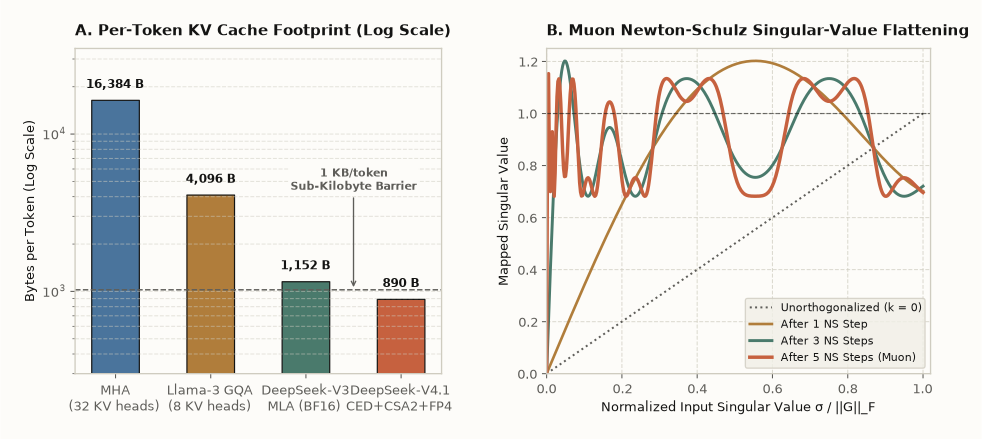
To push memory below , CSA2 partitions layers into static roles (Full, Reindex, and Reuse). Only Full layers materialize and store compressed KV latents quantized to native FP4 (E2M1 with E4M3 block scales), while Reuse layers attend directly over the preceding Full layer's cached tensors at zero marginal KV bytes. Combined with SWA Bounded Replay—which drops sliding-window KV from SSD prefix caches and recomputes only the trailing suffix on cache hit—global HBM KV footprint drops to 890 Bytes/token (a reduction vs. Llama-3-8B's 131,072 B/tok, fitting a -token trajectory in ).
In parallel, Qwen3.8-Next (arXiv:2608.30320[4]On the Design of Qwen3.8-Next Architecture: Evaluation, Efficiency, and Training StabilityOpen arXiv:2608.30320 ↗) pairs Gated DeltaNet () with sparse attention and offloads a 51B N-gram embedding table to Host DRAM via asynchronous prefetch—matching DeepSeek's 196B Engram lookup memory and cleanly separating compute parameters (MoE) from static memory parameters (off-accelerator lookup tables). Complex KDA (arXiv:2609.24797[6]Complex KDA: Understanding and Enhancing the Expressivity of Kimi Delta AttentionOpen arXiv:2609.24797 ↗) extends rank-1 Delta updates into the complex eigenvalue domain so a single step can represent 2D state rotations for formal state-tracking.
3.Depth-wise AttnRes and 4-branch gated residuals#
When depth reaches 93 layers (Kimi K3, arXiv:2607.24653[3]Kimi K3: Open Frontier IntelligenceOpen arXiv:2607.24653 ↗) or sparsity reaches (Qwen3.8-Next, arXiv:2608.30320[4]On the Design of Qwen3.8-Next Architecture: Evaluation, Efficiency, and Training StabilityOpen arXiv:2608.30320 ↗), standard x + f(RMSNorm(x)) residual addition dilutes early-layer signal and causes late-pretraining loss spikes. Both flagships replace blind summation with learned routing across the depth axis:
- Attention Residuals (
AttnRes, Kimi K3): Layer carries a learned pseudo-query vector that computes softmax attention weights over historical layer outputs : - 4-Branch Gated Residual (
GR, Qwen3.8-Next): Maintains parallel residual substreams . Each sublayer reads a softmax-gated mixture across the 4 streams and writes updates back through a bounded sigmoid gate .
class AttentionResidualRouter(nn.Module):
    """
    Depth-wise Attention Residuals (Kimi K3, arXiv:2607.24653; ARLoop, arXiv:2611.05234).
    Instead of summing all previous layers onto a single residual bus, a learned pseudo-query
    scores historical layer representations along the depth axis via softmax routing.
    """

    def __init__(self, hidden_size: int):
        super().__init__()
        self.pseudo_query = nn.Parameter(torch.randn(hidden_size) * 0.02)
        self.key_proj = nn.Linear(hidden_size, hidden_size, bias=False)
        self.scale = 1.0 / math.sqrt(hidden_size)

    def forward(self, layer_history: list[Tensor]) -> tuple[Tensor, Tensor]:
        stacked = torch.stack(layer_history, dim=2)  # [B, S, L_prev, H]
        keys = self.key_proj(stacked)
        logits = torch.einsum("bslh,h->bsl", keys, self.pseudo_query) * self.scale
        depth_weights = F.softmax(logits.float(), dim=-1).to(stacked.dtype)
        routed = torch.einsum("bsl,bslh->bsh", depth_weights, stacked)
        return routed, depth_weights.mean(dim=(0, 1))


class GatedResidual4Branch(nn.Module):
    """
    Four-branch Gated Residual stream (Qwen3.8-Next, arXiv:2608.30320).
    Maintains M=4 parallel residual substreams [B, S, 4, H], reading a gated combination
    before each sublayer and writing gated updates back to each branch.
    """

    def __init__(self, hidden_size: int, num_branches: int = 4):
        super().__init__()
        self.num_branches = num_branches
        self.read_gate = nn.Linear(hidden_size, num_branches, bias=False)
        self.write_gate = nn.Linear(hidden_size, num_branches, bias=False)

    def aggregate_for_sublayer(self, streams: Tensor) -> Tensor:
        mean_ctx = streams.mean(dim=2)
        alpha = F.softmax(self.read_gate(mean_ctx).float(), dim=-1).to(streams.dtype)
        return torch.einsum("bsm,bsmh->bsh", alpha, streams)

    def distribute_to_streams(self, streams: Tensor, sublayer_out: Tensor) -> Tensor:
        beta = torch.sigmoid(self.write_gate(sublayer_out)) * (2.0 / self.num_branches)
return streams + beta.unsqueeze(-1) * sublayer_out.unsqueeze(2)4.Muon 5-step Newton-Schulz and Blackwell FP4 co-design#
On NVIDIA Blackwell (B200/GB200), 4-bit Tensor Core MMA throughput scales far faster than Special Function Units (SFU) that compute exp2, turning Softmax exponentials into a kernel bottleneck (FlashAttention-4, arXiv:2603.05451[2]FlashAttention-4: Algorithm and Kernel Pipelining Co-Design for Asymmetric Hardware ScalingOpen arXiv:2603.05451 ↗, mitigates this via polynomial exp emulation on CUDA cores and asynchronous TMEM pipelines). At the optimizer level, AdamW's second-moment variance accumulator struggles with low-bit quantization and wastes HBM.
Muon (arXiv:2502.16982[1]Muon is Scalable for LLM TrainingOpen arXiv:2502.16982 ↗), adopted across DeepSeek-V4.1, Qwen3.8-Next, and Kimi K3, replaces diagonal preconditioning on 2D weight matrices with matrix orthogonalization: mapping the momentum matrix toward its nearest semi-orthogonal polar factor so every singular subspace receives equal update magnitude.
Given a 2D gradient or momentum matrix (transposed if so with ), first normalize by Frobenius norm so every singular value satisfies . Any odd polynomial acts elementwise on the singular values while preserving singular vectors and :
With minimax-tuned coefficients , iterating for uses only pure Tensor Core GEMMs (zero SVD calls) to push small singular values rapidly toward while contracting values above back into . Finally, multiplying by the Moonlight RMS scale matches AdamW's step-size variance across layer widths.
class AsymmetricCEDLayer(nn.Module):
    """
    Asymmetric Causal Encoder-Decoder (CED) layer with CSA2 cross-layer KV reuse
    (DeepSeek-V4.1-Flash, arXiv:2609.19969).
    - mode='full': projects and stores compressed KV state (simulated at FP4 = 0.5 B/elem).
    - mode='reuse': reuses the preceding full layer's KV cache with zero additional KV memory.
    """

    def __init__(self, hidden_size: int, ffn_dim: int, mode: str = "full"):
        super().__init__()
        if mode not in ("full", "reuse"):
            raise ValueError("mode must be 'full' or 'reuse'")
        self.mode = mode
        self.kv_dim = hidden_size // 4
        self.norm1 = nn.RMSNorm(hidden_size)
        self.wq = nn.Linear(hidden_size, self.kv_dim, bias=False)
        if mode == "full":
            self.wk = nn.Linear(hidden_size, self.kv_dim, bias=False)
            self.wv = nn.Linear(hidden_size, self.kv_dim, bias=False)
        self.wo = nn.Linear(self.kv_dim, hidden_size, bias=False)
        self.norm2 = nn.RMSNorm(hidden_size)
        self.ffn = nn.Sequential(
            nn.Linear(hidden_size, ffn_dim, bias=False),
            nn.SiLU(),
            nn.Linear(ffn_dim, hidden_size, bias=False),
        )

    def forward(
        self, x: Tensor, shared_kv: tuple[Tensor, Tensor] | None = None
    ) -> tuple[Tensor, tuple[Tensor, Tensor], int]:
        _, seq_len, _ = x.shape
        h = self.norm1(x)
        q = self.wq(h)
        if self.mode == "full":
            k, v = self.wk(h), self.wv(h)
            new_kv_bytes = int((k.numel() + v.numel()) * 0.5)
        else:
            if shared_kv is None:
                raise ValueError("reuse layer requires shared_kv from a preceding full layer")
            k, v = shared_kv
            new_kv_bytes = 0

        scores = torch.matmul(q, k.transpose(-2, -1)) / math.sqrt(self.kv_dim)
        mask = torch.triu(torch.full((seq_len, seq_len), float("-inf"), device=x.device), diagonal=1)
        attn = F.softmax((scores + mask).float(), dim=-1).to(x.dtype)
        x = x + self.wo(torch.matmul(attn, v))
        x = x + self.ffn(self.norm2(x))
        return x, (k, v), new_kv_bytes


def muon_newton_schulz_5step(grad: Tensor, steps: int = 5, eps: float = 1e-7) -> Tensor:
    """
    Muon 5-step Newton-Schulz matrix orthogonalization (arXiv:2502.16982).
    Applies the tuned quintic odd polynomial to flatten singular values toward 1,
    approximating the polar factor U @ V^T with Moonlight RMS scaling.
    """
    if grad.ndim != 2:
        raise ValueError("grad must be a 2D matrix")
    a, b, c = (3.4445, -4.7750, 2.0315)
    x = grad.float()
    transposed = x.size(0) > x.size(1)
    if transposed:
        x = x.T
    x = x / (x.norm() + eps)
    for _ in range(steps):
        gram = x @ x.T
        poly = b * gram + c * (gram @ gram)
        x = a * x + poly @ x
    if transposed:
        x = x.T
    scale = 0.2 * math.sqrt(max(grad.size(0), grad.size(1)))
    return x.to(grad.dtype) * scale
In our companion CPU verification (labs/llm/flagship-2026), AsymmetricCEDLayer confirms zero marginal KV bytes on Reuse layers with a Encoder/Decoder FFN parameter ratio, while muon_newton_schulz_5step collapses an ill-conditioned gradient matrix (condition number ) by more than two orders of magnitude in five pure matrix multiplications.
5.References#
- Jordan et al., Muon is Scalable for LLM Training (2025).
- Shah et al., FlashAttention-4: Algorithm and Kernel Pipelining Co-Design for Asymmetric Hardware Scaling (2026).
- Moonshot AI, Kimi K3: Open Frontier Intelligence (2026) and Complex KDA (2026).
- Qwen Team, On the Design of Qwen3.8-Next Architecture: Evaluation, Efficiency, and Training Stability (2026).
- DeepSeek-AI, DeepSeek-V4.1-Flash: Pushing the Limits of KV Cache Compression (2026).
- NVIDIA, Nemotron 3.5 Super and Lightning (2026).
- Continue to Chapter 8: Looped Transformers: Latent-Space Recurrence, Constant Terminal KV Cache, and Elastic Depth.
References
- [1]
- [2]
- [3]
- [4]
- [5]
- [6]
- [7]